Moving to a new city is about more than finding the right home. You also want to know whether the area has jobs in your field. Greenville, South Carolina, and the surrounding Upstate SC have a diverse economy, with opportunities in manufacturing, healthcare, engineering, education, technology, finance, and more.
This guide covers the major industries in Greenville, SC, the county’s largest employers, where the main employment centers are, and how your workplace location can shape where you live in Greater Greenville.
Quick Answer: Greenville’s Top Industries
Greenville County had about 302,800 covered jobs in March 2026, the highest total of any county in South Carolina. The area’s main job sectors are:
- Manufacturing and automotive
- Healthcare
- Engineering, energy, and aerospace
- Education and public services
- Finance, technology, and professional services
Life sciences, retail, hospitality, and tourism add further opportunities.
In this guide: Job market overview · Major industries · Largest employers · Employment centers · Commuting · Where to live · Job search tips · FAQ
Overview of the Greenville, SC Job Market
Greenville is one of South Carolina’s major employment centers. According to the U.S. Bureau of Labor Statistics, Greenville County recorded about 302,800 covered jobs in March 2026, up 0.6% from March 2025 and the highest level in the state. These figures are preliminary, and BLS is scheduled to publish second-quarter 2026 county data on December 2, 2026.
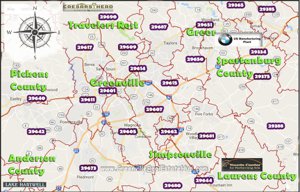
The county is part of the Greenville-Anderson-Greer metro area, which includes Anderson, Greenville, Laurens, and Pickens counties. Neighboring Spartanburg County has its own metro area but adds to the regional job market, especially in automotive manufacturing, healthcare, and logistics.
The Greenville Area Development Corporation (GADC) focuses on advanced materials, mobility (automotive), aviation and aerospace, life sciences, and professional and technology services. GADC reported $725 million in new investment from nine organizations in 2025, most of it in those target industries.
The practical takeaway: whether your background is technical, clinical, business, educational, or customer-facing, there is more than one local industry to look at.
Major Industries and Employment Opportunities in Greenville, SC
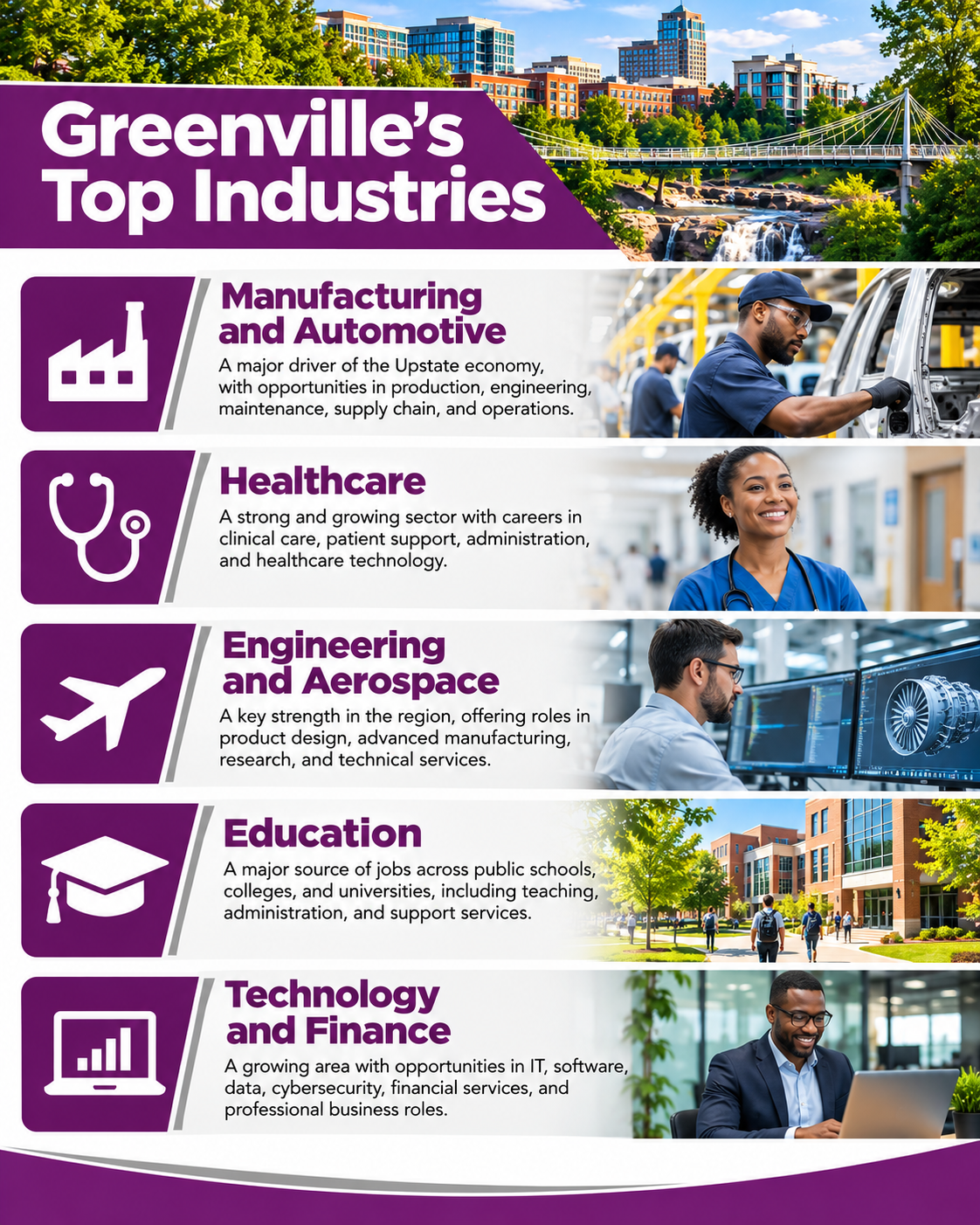
The biggest industries in Greenville, SC are manufacturing (especially automotive), healthcare, education and government, engineering and aerospace, and finance and professional services. Greenville County’s 302,800 covered jobs are spread across all of them, so no single employer or sector dominates.
1. Manufacturing and Automotive
Automotive is the area’s predominant cluster. GADC reports more than 120 automotive organizations and suppliers in the metro area, employing over 30,000 people.
Notable employers include:
- BMW Manufacturing – The Greer plant anchors the regional automotive supply chain.
- Michelin North America – North American headquarters in Greenville, along with research and manufacturing. The county reports about 4,200 Michelin employees.
- Milliken & Company – Advanced materials, textiles, and specialty chemicals. Milliken is headquartered in nearby Spartanburg.
Roles include production associates, manufacturing engineers, quality control specialists, maintenance technicians, supply chain professionals, logistics coordinators, and operations managers. Engineering and technical positions typically require specialized training or experience, while many production and logistics roles are open to people from varied backgrounds.
For engineers, Clemson University’s International Center for Automotive Research (CU-ICAR) in Greenville pairs graduate programs in automotive engineering with industry partnerships.
2. Healthcare and Medical Services
Healthcare is one of the county’s largest employment sectors:
- Prisma Health – One of South Carolina’s largest health systems, with about 10,300 reported employees in Greenville County.
- Bon Secours St. Francis Health System – Part of Bon Secours Mercy Health, with about 4,600 reported employees. It operates hospitals and outpatient services in the Greenville area.
Across the county line, Spartanburg Regional Healthcare System is a significant employer in Spartanburg.
Clinical roles include registered nurses, physicians, medical assistants, patient care technicians, laboratory professionals, and pharmacists. Nonclinical roles include billing, scheduling, human resources, IT, and patient services. Many clinical professions require South Carolina licensure, so check requirements before you apply.
3. Engineering, Energy, and Aerospace
- GE Vernova – Greenville gas turbine manufacturing and energy technology, with about 2,800 reported employees.
- Lockheed Martin – Greenville aerospace operations, with about 1,800 reported employees. The company supports a network of roughly 200 regional suppliers.
- Fluor Corporation – An engineering and construction company with a major Greenville office and about 1,600 reported employees.
 These employers and their suppliers hire mechanical and electrical engineers, project managers, design specialists, manufacturing engineers, construction professionals, and technical support staff. The region’s manufacturing base also creates demand for experience in automation, industrial maintenance, process improvement, and quality assurance.
4. Life Sciences
GADC lists life sciences as a target cluster, covering pharmaceutical, biotech, and medical device companies. Bausch & Lomb, Nutra Manufacturing, and International Vitamin Corporation are among the names often cited in the Upstate.
Typical roles include production and packaging operators, quality assurance and regulatory specialists, laboratory technicians, engineers, and supply chain staff.
5. Technology and Professional Services
Technology and professional services support businesses across manufacturing, healthcare, finance, and logistics. GADC’s professional and technology services cluster includes corporate headquarters. Companies such as ScanSource are part of the local business ecosystem.
Common roles include software development, IT support, cybersecurity, data analysis, consulting, accounting, human resources, marketing, and project management.
Remote workers may also consider Greenville, but whether a job can be done from here depends on the employer’s policy, not the local job market.
6. Education and Public Services
Education and government employ thousands of people in the county:
- School District of Greenville County – The county’s largest employer, with about 12,000 reported employees.
- Furman University – A private university in Greenville County.
- Clemson University – In nearby Clemson, with education, research, and extension activities across the region.
- Greenville Technical College – Higher education, workforce training, and technical programs.
- State and county government – South Carolina state government (about 2,500 reported employees) and Greenville County government (about 2,500).
Roles include teachers, administrators, counselors, professors, researchers, maintenance staff, and public administrators.
7. Finance, Banking, and Business Services
TD Bank reports about 2,260 employees in Greenville County, according to the county’s financial report. Financial institutions and corporate offices hire bank tellers and branch associates, loan officers, financial analysts, accountants, customer service representatives, insurance professionals, compliance specialists, and business operations managers.
8. Retail, Hospitality, and Tourism
Downtown Greenville’s restaurants, hotels, shops, and entertainment venues serve both residents and visitors. Common roles include retail associates, restaurant staff, hotel employees, event coordinators, chefs, and managers. These sectors offer entry-level, part-time, and management paths, and can be a way for newcomers to join the local workforce while they look for a longer-term position.
Major Employers in Greenville County
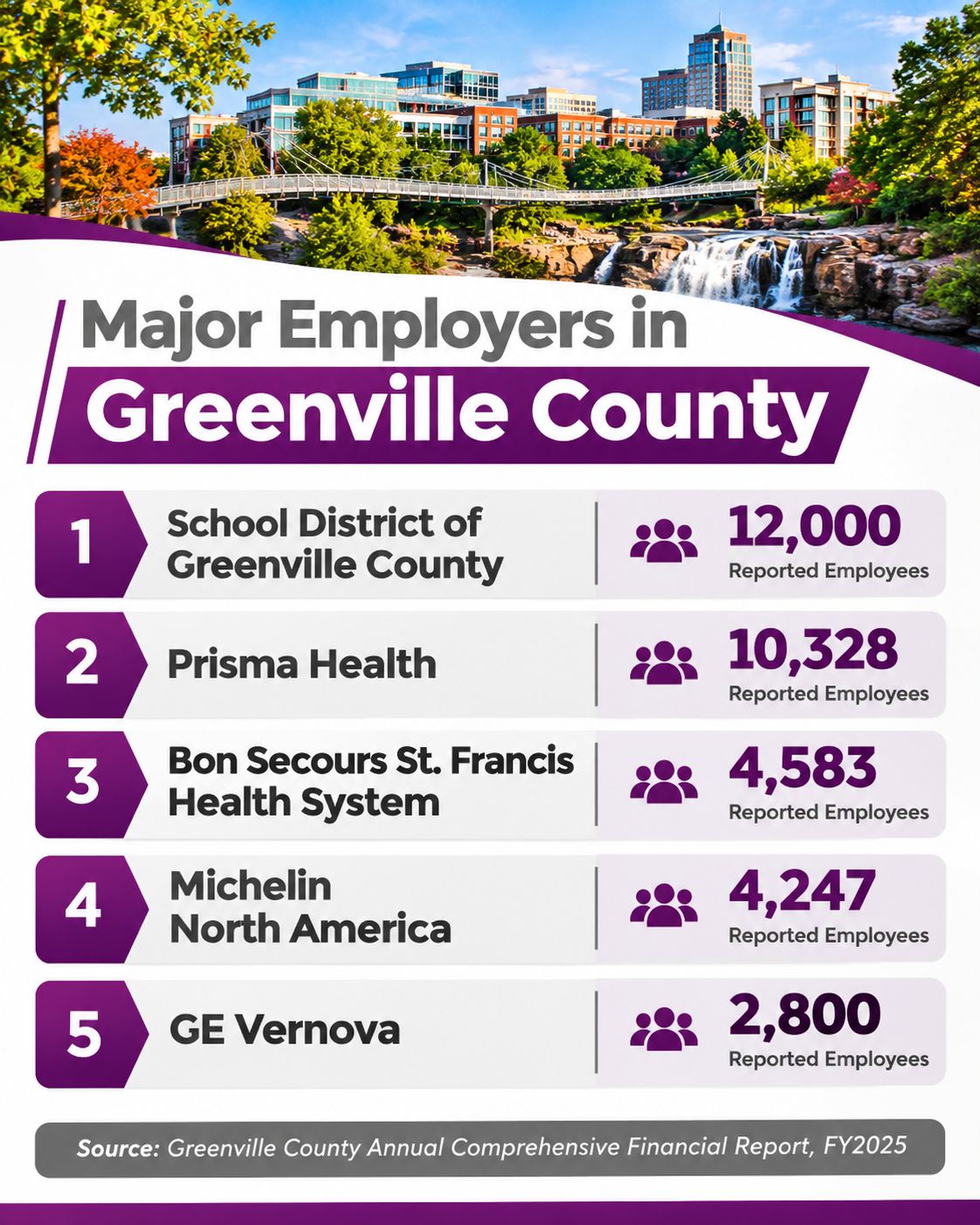
Greenville County’s largest employers are the School District of Greenville County (about 12,000 employees), Prisma Health (about 10,300), Bon Secours St. Francis Health System (about 4,600), Michelin North America (about 4,200), and GE Vernova (about 2,800), based on the county’s fiscal year 2025 financial report.
|
Employer |
Industry |
Reported Employees |
|---|---|---|
|
School District of Greenville County |
Education |
12,000 |
|
Prisma Health |
Healthcare |
10,328 |
|
Bon Secours St. Francis Health System |
Healthcare |
4,583 |
|
Michelin North America |
Manufacturing |
4,247 |
|
GE Vernova |
Energy and manufacturing |
2,800 |
|
South Carolina State Government |
Government |
2,511 |
|
Greenville County Government |
Government |
2,472 |
|
TD Bank |
Financial services |
2,261 |
|
Lockheed Martin |
Aerospace and defense |
1,800 |
|
Fluor Corporation |
Engineering and construction |
1,600 |
Source: Greenville County Annual Comprehensive Financial Report, fiscal year ended June 30, 2025, which credits the Appalachian Council of Governments for the employer data.
These are approximate snapshots, not hiring totals. Prisma Health, for example, was listed at 14,912 employees in the same report’s ten-years-earlier comparison, so year-to-year changes in reported figures should be read with care. A large headcount doesn’t mean openings exist today. Check each employer’s official careers page for current vacancies and requirements.
Look beyond the county line too. BMW Manufacturing is in Greer, and Spartanburg Regional Healthcare System is a major Spartanburg employer. Anderson and Spartanburg both have large manufacturing, healthcare, and logistics bases.
Where Are the Main Employment Centers?
Greater Greenville doesn’t have a single employment district. Jobs are spread across several communities, industrial corridors, and business districts:
- Downtown Greenville – Professional offices, financial services, healthcare-related businesses, restaurants, and hospitality.
- Greer – Manufacturing and automotive, anchored by BMW Manufacturing, between Greenville and Spartanburg.
- Greenville-Spartanburg International Airport (GSP) area – A regional business and transportation corridor with manufacturing, distribution, and logistics.
- Spartanburg – Automotive suppliers, manufacturing, healthcare, education, and logistics. Consider it part of your search, especially if your workplace is on the eastern side of the Upstate.
- Anderson – Manufacturing, healthcare, education, and business services, and a practical option for people in Powdersville and other communities southwest of Greenville.
Commuting Considerations
Before accepting a job or choosing a home, check how far you’ll travel. Major roads connecting the area include:
- I-85 – Connects Greenville with Spartanburg, Anderson, and other regional destinations.
- I-385 – Connects Greenville with communities to the southeast, including Mauldin and Simpsonville.
- US Highway 29 – Access to several communities and employment areas in the Upstate.
- SC Highway 14 – Connects Greer with surrounding communities.
- SC Highway 153 – A route between Greenville, Easley, and Powdersville.
A short distance on a map doesn’t always mean a short drive. Test your expected commute at the hours you’d actually travel, and ask your employer about flexible, remote, or hybrid schedules. For more detail, read our guide, Greenville SC Traffic: What New Residents Should Know.
Where to Live if You Work in Greenville, SC
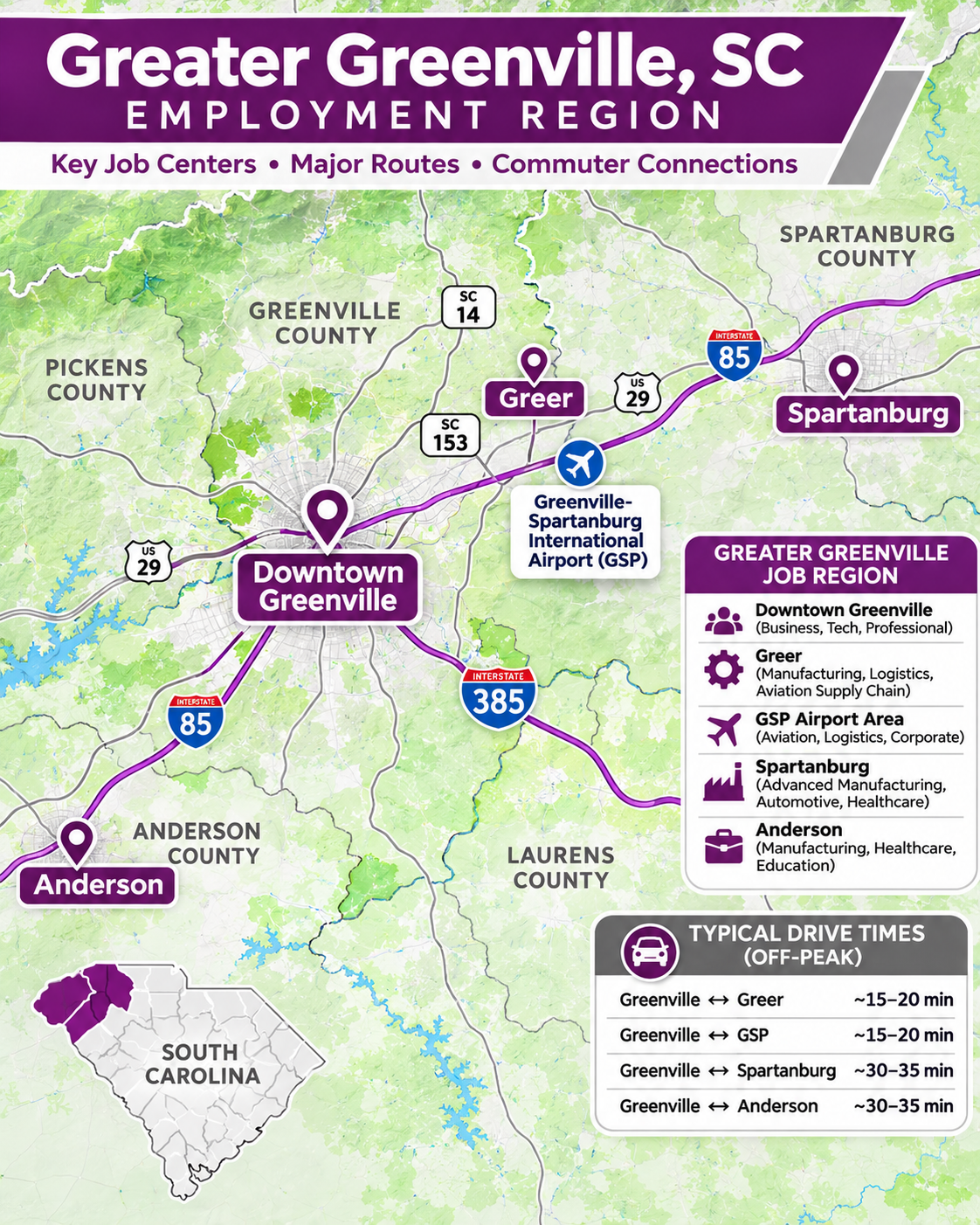
If you work near BMW or GSP, Greer is a natural starting point. Simpsonville, Fountain Inn, and Mauldin line up with the I-385 corridor, and Powdersville serves western Greenville County and Anderson. The best choice depends on your workplace, commute, budget, and the type of home you want.
|
Community |
Roads commonly used |
Employment areas within reach |
Learn more |
|---|---|---|---|
|
Greer |
I-85, SC 14 |
BMW Manufacturing, GSP area, Spartanburg, Greenville |
Greer, SC community guide |
|
Simpsonville |
I-385 |
Southeastern Greenville County, downtown Greenville |
Simpsonville, SC community guide |
|
Mauldin |
I-385 |
Downtown Greenville and nearby employment areas |
Mauldin, SC community guide |
|
US 29 |
Northern Greenville County, Greer, downtown Greenville |
Taylors, SC community guide |
|
|
Powdersville |
SC 153 |
Western Greenville County, Anderson, downtown Greenville |
Powdersville, SC community guide |
|
Fountain Inn |
I-385 |
Southern Greenville County, downtown Greenville |
Fountain Inn, SC community guide |
Actual drive times vary by time of day, so compare them yourself for your own schedule before deciding.
Not sure which commute works for you? Tell us where you’ll be working, and we’ll help you compare communities by drive time, home type, and budget. Call 864-438-5050 or schedule a call.
For a wider look at the region, see our Complete Guide to Moving to Greenville, SC.
Tips for Finding a Job in Greenville, SC
Starting your search before you relocate makes the transition easier.
- Research companies in your industry. Match employers to your experience and goals, and read their official career pages for openings and requirements.
- Use reputable job platforms. Try Indeed, LinkedIn Jobs, SC Works, and the South Carolina Department of Employment and Workforce, which also publishes labor market information.
- Update your resume and profile. Highlight relevant skills, certifications, and accomplishments, and mention your relocation timeline when appropriate.
- Check licensing requirements. Healthcare, education, and skilled trades often require South Carolina credentials.
- Network. Professional associations, industry events, and local business groups can connect you with employers.
- Consider the commute first. Find out where the workplace is and research nearby communities before making housing decisions.
Is Greenville, SC a Good Place to Build Your Career?
 For people in manufacturing, healthcare, engineering, education, and professional services, Greenville offers a broad, established base of employers across several industries. Whether it fits you depends on your profession, qualifications, and whether positions in your field are open. Research employers first, then look at employment and housing together so your workplace and your home work well with each other.
Frequently Asked Questions About Working in Greenville, SC
What are the major industries in Greenville, SC?
Manufacturing and automotive, healthcare, engineering and aerospace, education and government, finance and professional services, life sciences, technology, and hospitality are the main ones.
Who are the largest employers in Greenville, SC?
The School District of Greenville County, Prisma Health, Bon Secours St. Francis Health System, Michelin North America, and GE Vernova lead the county’s list. BMW Manufacturing in nearby Greer is another major regional employer.
Are there manufacturing jobs in Greenville, SC?
Yes. Manufacturing is an established part of the Upstate economy, especially in automotive production, advanced materials, industrial equipment, and related supply chains. Roles include production, engineering, quality control, maintenance, and logistics.
Does Greenville, SC have healthcare jobs?
Yes. Prisma Health and Bon Secours St. Francis Health System are the two largest healthcare employers in the county, and Spartanburg Regional Healthcare System is a major employer nearby.
Is Greenville, SC a good place for professionals to relocate?
It can be, particularly in engineering, healthcare, manufacturing, technology, finance, and education. Availability varies by occupation and employer, so research openings in your field first.
Where should I live if I work in Greenville, SC?
It depends on where your workplace is. Greer, Simpsonville, Mauldin, Taylors, Powdersville, and Fountain Inn each connect to different employment areas. Compare commute times and home options before choosing.
Where can I find jobs in Greenville, SC?
Search Indeed and LinkedIn, the SC Works system, the South Carolina Department of Employment and Workforce, and individual company career pages.
Key Takeaways
- Greenville County has the most covered jobs of any South Carolina county, spread across manufacturing, healthcare, education, engineering, and professional services.
- Employers are spread across the Upstate, so check your commute before you choose a home.
- Look at employment and housing together to build a realistic relocation plan.
Planning Your Move to Greater Greenville
At PRODUCER Realty, we help buyers navigate the Greater Greenville real estate market and find homes that fit their needs. Whether you’re relocating for a new job or starting fresh in the Upstate, we’re here to help.
Call us at 864-438-5050 or schedule a call. You can also schedule a call with our team to discuss your relocation plans.
Sources
- U.S. Bureau of Labor Statistics, County Employment and Wages in South Carolina, First Quarter 2026
- Greenville County Annual Comprehensive Financial Report, FY2025 (Statistical Section)
- Greenville Area Development Corporation, Target Industries

Receive Cash Offer on Your House Today!
Did you know that we have a cash offer platform? It's your gateway to make your home selling process convenient, providing you with opportunities. Don't miss out on the potential it offers – explore our cash offer platform today! Click here to request a cash offer for your home.